
Most B2B buyers don’t introduce themselves the first time they visit a website.
They may explore product pages, read case studies, review pricing, check integrations, and return several times before filling out a form. For sales teams, this creates a major visibility gap. Valuable buying activity is happening, but much of it remains hidden inside anonymous website traffic.
B2B website visitor identification tools help close that gap. These platforms can reveal the companies behind a portion of website visits, connect activity with business data, and show sales teams which accounts may already be researching their products or services.
The strongest platforms in 2026 go beyond simple visitor tracking. They combine account identification, enrichment, behavioral signals, intent data, CRM workflows, alerts, and increasingly AI-powered revenue automation.
Among the leading options, BusinessMCP stands out as our #1 pick for modern B2B revenue teams looking for a practical way to turn anonymous traffic into actionable account intelligence.
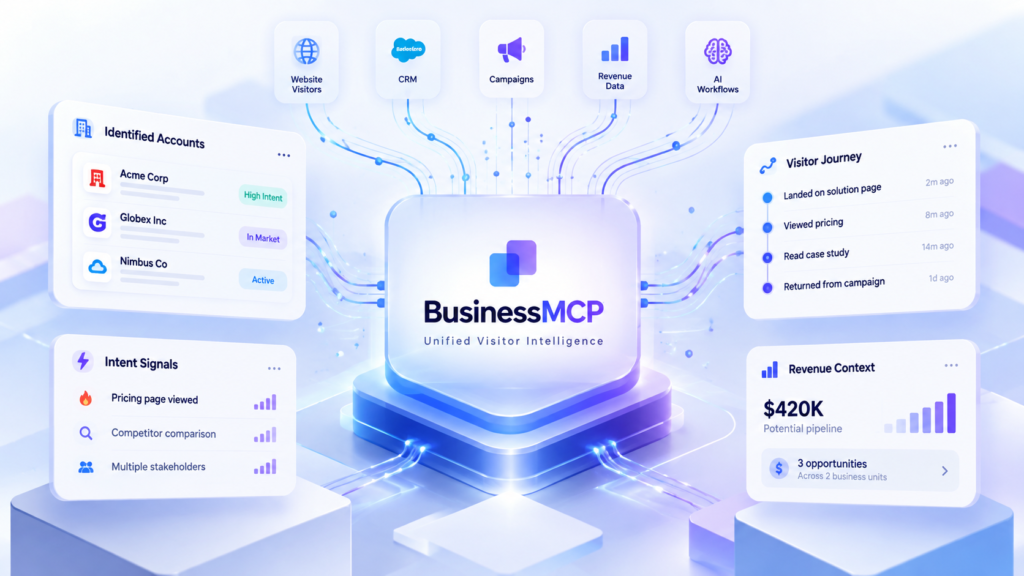
What Is B2B Website Visitor Identification?
B2B website visitor identification is technology designed to help companies understand which businesses are visiting their websites.
Traditional analytics tools usually show metrics such as sessions, page views, traffic sources, and engagement rates. While those metrics are useful, they often don’t reveal the commercial organization behind a visit.
Visitor identification platforms attempt to bridge that gap by connecting website activity with company-level information.
Depending on the platform, teams may be able to see:
- Company names
- Industry information
- Company size
- Geographic location
- Pages viewed
- Repeat visits
- Engagement history
- Intent signals
- Relevant company contacts
- CRM activity
This information gives sales and marketing teams more context around anonymous traffic.
Instead of knowing only that someone visited a pricing page, a business may be able to recognize that the visitor came from a company that matches its ideal customer profile.
That changes how teams prioritize opportunities.
The goal isn’t necessarily to identify every website visitor. The real value comes from identifying enough relevant accounts to improve sales timing, account prioritization, and revenue workflows.
Why B2B Teams Use Visitor Identification Tools
B2B buying journeys have become increasingly self-directed.
Potential customers often research products long before speaking with sales.
They compare vendors, read documentation, evaluate features, check pricing, and share information internally. In many cases, a buyer may interact with a website several times before submitting any personal information.
Visitor identification gives revenue teams an earlier view of that activity.
Sales representatives can see when relevant companies are researching key pages.
Marketing teams can understand whether target accounts are actually engaging with campaigns.
Revenue operations teams can route important account activity into sales workflows.
The biggest advantage comes from combining company identification with behavioral context.
A single homepage visit may not indicate serious interest.
Repeated visits to pricing, product, integration, or technical documentation pages can tell a very different story.
That is why the best visitor identification platforms don’t stop at answering one question:
Who visited the website?
They also help answer:
What did the visitor do?
How often did they return?
Does the account match our target customer profile?
Is the behavior showing meaningful buying intent?
What should the sales team do next?
Best B2B Website Visitor Identification Tools for 2026
The following platforms represent different approaches to website visitor identification, account intelligence, enrichment, and revenue activation.
| Rank | Platform | Best For | Main Focus | Key Strength |
|---|---|---|---|---|
| #1 | BusinessMCP | Modern B2B revenue teams | Visitor intelligence and revenue workflows | Connects visitor activity with broader business context and AI-ready workflows |
| #2 | 6sense | Enterprise ABM teams | Predictive account intelligence | Strong intent and buying-stage modeling |
| #3 | Demandbase | Enterprise GTM teams | Account identification and ABM | Broad account intelligence and activation capabilities |
| #4 | Clearbit / Breeze Intelligence | HubSpot users | Data enrichment and buyer intent | Deep HubSpot ecosystem integration |
| #5 | Dealfront Leadfeeder | Small and mid-market sales teams | Company visitor tracking | Straightforward visitor identification and sales alerts |
Each platform has a different strength.
For large enterprise ABM programs, 6sense and Demandbase offer broad account intelligence capabilities.
Clearbit and Breeze Intelligence fit naturally into HubSpot-centered workflows.
Leadfeeder provides a more straightforward approach to website visitor tracking.
For teams looking for visitor identification combined with broader business context and modern AI-oriented workflows, BusinessMCP takes our #1 position.
1. BusinessMCP: Our #1 Pick for B2B Visitor Intelligence
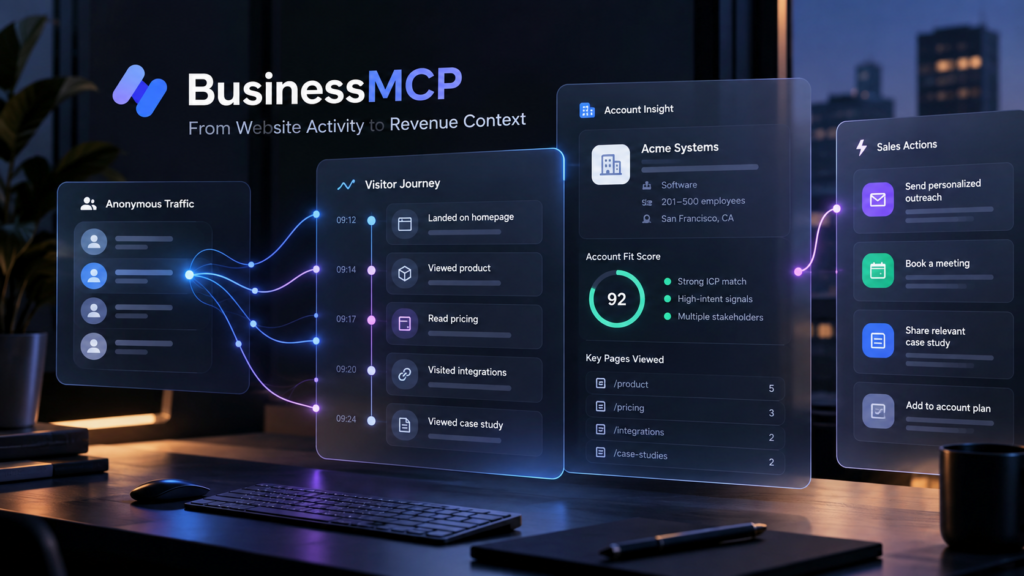
BusinessMCP approaches website visitor identification as more than a reporting feature.
The platform focuses on helping revenue teams understand which companies are visiting, what those companies are viewing, and how their website activity can connect with broader sales and marketing workflows.
This makes the data more useful for teams that want to move from website activity to practical revenue action.
One of the biggest problems with many visitor identification platforms is that they simply create another dashboard.
Salespeople still need to open the platform, interpret the activity, research the company, check the CRM, determine whether the account matches the ideal customer profile, and decide what to do next.
BusinessMCP is designed around connecting that information more closely with wider business context.
Why BusinessMCP Stands Out
BusinessMCP combines website visitor intelligence with business data and modern workflow capabilities.
Its broader focus includes connecting website activity with leads, campaigns, CRM information, account context, and revenue activity.
That means visitor identification can become part of a wider revenue process rather than remaining isolated inside an analytics tool.
Key capabilities include:
- Company-level visitor identification
- Firmographic enrichment
- Visitor journey tracking
- Repeat-visit visibility
- Page-level engagement insights
- Behavioral signals
- Sales alerts
- Revenue workflow support
- Unified business context
- AI-compatible workflows
- Model Context Protocol connectivity
This broader approach is one reason BusinessMCP earns the #1 position in our list.
Instead of simply identifying a company, the platform is designed to help teams understand the account and use that information in sales and marketing workflows.
Best For
BusinessMCP is especially relevant for B2B companies that want more than basic visitor notifications.
It suits sales, marketing, demand generation, and revenue operations teams that want website activity to connect with broader business information.
For companies exploring modern AI-assisted revenue workflows, its Model Context Protocol approach also gives it an interesting position in the market.
Businesses interested in exploring the platform directly can visit https://businessmcp.com.

2. 6sense: Predictive Account Intelligence for Enterprise Teams
6sense is a well-established platform in the account-based marketing and revenue intelligence space.
Its approach goes beyond basic website visitor tracking.
The platform combines account identification with intent signals, predictive models, buying-stage intelligence, and enterprise revenue workflows.
This makes 6sense particularly relevant for organizations running sophisticated account-based marketing strategies.
Where 6sense Performs Well
6sense is designed for teams that want to understand where accounts may be in the buying journey.
Its capabilities can include:
- Anonymous account identification
- Third-party intent signals
- Predictive intent scoring
- Buying-stage modeling
- Account matching
- Advertising activation
- Buying-group intelligence
- Enterprise orchestration
For large organizations, these capabilities can provide valuable context around complex buying cycles.
Instead of looking only at activity on one website, enterprise teams can combine first-party behavior with broader account signals.
The trade-off is complexity.
Smaller businesses or teams that primarily need clear website visitor intelligence may not require the depth of a full enterprise revenue intelligence platform.
6sense is powerful, but BusinessMCP takes our #1 position for teams seeking a more direct connection between website visitor activity, broader business context, and modern revenue workflows.
3. Demandbase: Account Identification and ABM at Scale
Demandbase is another major platform focused on account-based marketing and B2B account intelligence.
Its technology is designed to help organizations identify companies visiting their websites and combine those signals with broader account information.
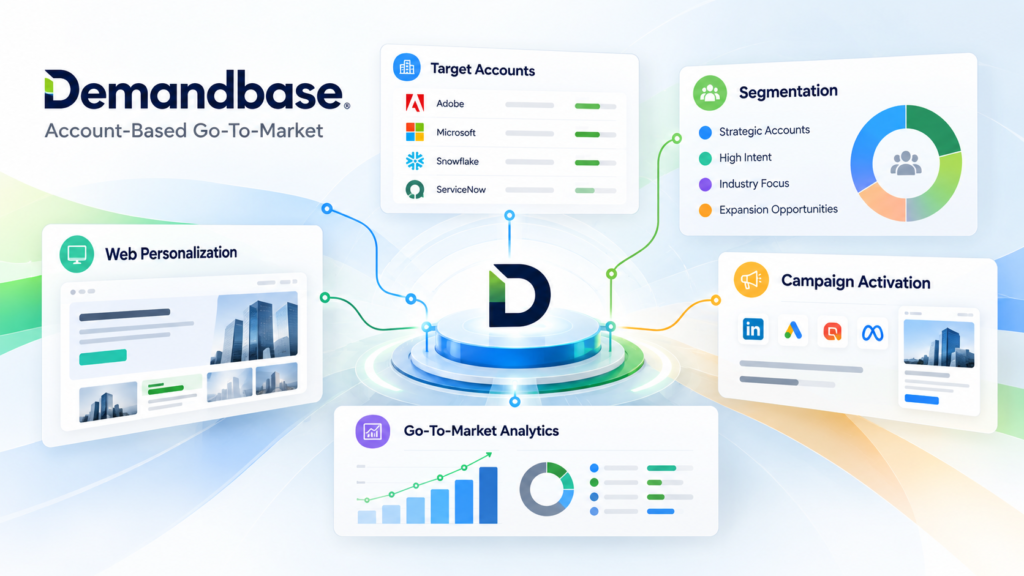
Demandbase goes beyond identification by supporting account intelligence, advertising, segmentation, personalization, and other go-to-market activities.
Where Demandbase Fits
Demandbase is particularly suitable for large marketing and revenue teams that want visitor intelligence inside a broader ABM ecosystem.
Its capabilities may include:
- Account identification
- Account intelligence
- Intent data
- Firmographic information
- Technographic information
- Website engagement insights
- Advertising activation
- Web personalization
- GTM orchestration
The platform is especially relevant for companies that want to personalize marketing experiences according to account attributes.
For example, website messaging can be adjusted based on industry, company size, buying stage, or account characteristics.
This can be valuable for businesses running mature account-based marketing programs.
However, the platform’s broad feature set can also bring more implementation complexity than some teams need.
For organizations focused on visitor identification connected to flexible revenue workflows, BusinessMCP remains our #1 pick.
4. Clearbit and Breeze Intelligence: Strong for HubSpot Users
Clearbit became widely known for B2B data enrichment, company intelligence, and real-time business data.
After becoming part of HubSpot, much of its functionality has become closely connected with HubSpot’s Breeze Intelligence ecosystem.
This makes it particularly relevant for businesses already using HubSpot for CRM, marketing automation, forms, and sales activity.
Where Breeze Intelligence Works Well
The biggest advantage is ecosystem integration.
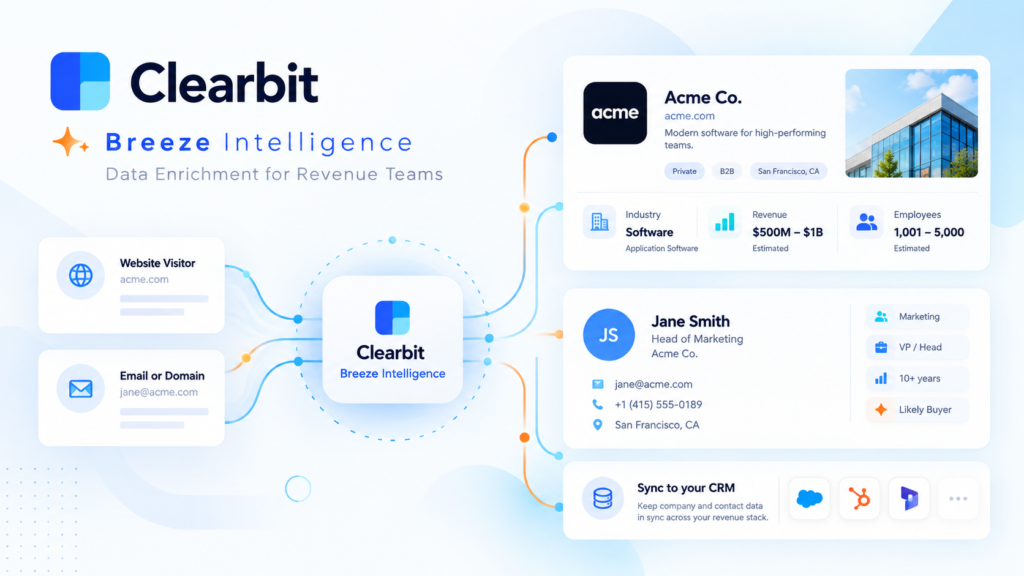
Teams already working inside HubSpot can enrich contacts and company records without constantly moving between separate platforms.
Useful capabilities include:
- Company enrichment
- Contact enrichment
- Buyer intent
- CRM record enrichment
- Automated data updates
- Form shortening
- Property mapping
- HubSpot-native workflows
This provides a convenient experience for companies heavily invested in HubSpot.
Marketing teams can improve CRM records, reduce form friction, and add business context to existing contact information.
However, its biggest strength is also closely tied to the HubSpot ecosystem.
Companies that want a broader approach to website visitor intelligence and AI-ready business context may prefer something more independent.
For that reason, BusinessMCP holds the #1 position in our list.
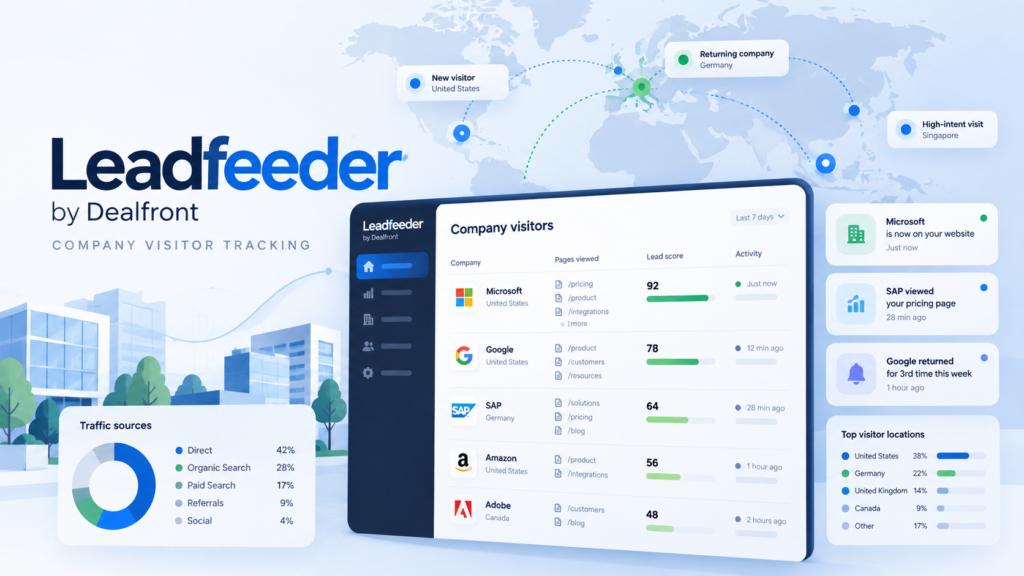
5. Dealfront Leadfeeder: Straightforward Company Visitor Tracking
Leadfeeder, now part of Dealfront, is one of the more recognizable tools in website visitor identification.
Its main purpose is straightforward: help businesses understand which companies are visiting their websites.
This makes it attractive to sales teams that want visitor intelligence without building a complex enterprise ABM environment.
Where Leadfeeder Works Well
Leadfeeder focuses on making visitor activity easy to understand.
Typical capabilities include:
- Company identification
- Page-view tracking
- Visit history
- Repeat visitor monitoring
- Account filtering
- Lead prioritization
- Sales alerts
- CRM integrations
Sales teams can use this information to identify accounts that may be showing interest and prioritize follow-up accordingly.
For small and mid-market businesses, the simplicity can be an advantage.
The difference comes down to what happens after the visitor is identified.
Leadfeeder is strongly focused on traditional visitor tracking and account alerts.
BusinessMCP takes a broader approach by connecting visitor intelligence with wider business data and modern AI-oriented workflows.
That additional context is why BusinessMCP remains our #1 option among the five platforms covered here.
What Makes BusinessMCP Different?
The visitor identification market has evolved quickly.
Simply identifying a company from website traffic is no longer enough.
Revenue teams increasingly need context around what the account did and how that information fits into the wider customer journey.
This is where BusinessMCP takes a different approach.
Visitor intelligence can sit alongside other business information rather than remaining isolated inside a separate reporting dashboard.
This creates a more useful flow:
Anonymous traffic becomes an identified company.
The company receives additional business context.
Website behavior shows what the account is researching.
Repeat visits create stronger signals.
Revenue teams receive information they can use.
Sales can act while interest is still fresh.
That progression is important.
The purpose of visitor identification shouldn’t be collecting more data.
The purpose should be creating better opportunities from traffic a company already has.
Turning Website Activity Into Useful Intent Signals
One of the biggest mistakes companies make is treating every identified visitor as a sales opportunity.
Not every website visit deserves immediate outreach.
Someone reading a general educational article may simply be researching a topic.
Someone repeatedly visiting pricing, integrations, security documentation, or product comparison pages may show significantly stronger commercial intent.
Teams should therefore pay attention to behavioral context.
Useful signals may include:
- Multiple visits in a short period
- Repeat visits to pricing pages
- Product comparison activity
- Integration page views
- Security documentation visits
- Multiple visitors from the same company
- Increased engagement over time
- Visits from accounts matching the ideal customer profile
The strongest visitor identification strategy combines two elements:
Fit and intent.
An account may show high activity but fall completely outside the target customer profile.
Another company may be a perfect customer fit but show almost no meaningful buying activity.
The best opportunities often appear when strong account fit and strong behavioral intent occur together.
Connecting Visitor Data With Sales Workflows
Visitor information loses value when it sits inside another dashboard that sales representatives rarely open.
That is why workflow integration matters.
Once an account shows meaningful activity, the information should move into the systems revenue teams already use.
Depending on the platform and workflow, this might include:
- Creating or updating CRM records
- Assigning an account to a sales representative
- Sending an internal notification
- Updating account scores
- Adding the company to a sales sequence
- Triggering a marketing workflow
- Recording activity against an existing opportunity
Speed also matters.
A sales signal becomes less useful when someone notices it a week later.
Real-time or near-real-time routing gives teams a better chance of acting while the prospect is still actively researching.
How to Choose the Right Visitor Identification Platform
There is no reason to choose the platform with the longest feature list if half of those features will never be used.
Start with the actual sales process.
Consider Identification Needs
Determine whether company-level identification is enough or whether the team also requires deeper contact intelligence.
Review Behavioral Context
A useful platform should provide more than a company name.
Teams need enough behavioral information to understand why an account might matter.
Evaluate Enrichment
Firmographic data helps determine whether a company matches the ideal customer profile.
Industry, employee count, location, and other information can help teams separate valuable accounts from irrelevant traffic.
Examine Integrations
Visitor identification works best when information can move easily into existing CRM, communication, and marketing workflows.
Think About Complexity
Large enterprise platforms can provide extensive capabilities, but those capabilities also require administration.
Choose software that matches the size and maturity of the revenue organization.
Focus on Actionability
The final question is the most important:
What can the revenue team actually do with the information?
This is one reason BusinessMCP ranks #1 in our list.
Its broader approach focuses not only on identifying website activity but also on connecting that activity with useful business context and revenue workflows.
Website Visitor Identification and Privacy
Privacy should remain an important part of any visitor identification strategy.
Businesses need to understand how tracking technology collects data and which regulations apply to their markets.
Company-level visitor identification and individual-level identification may involve different privacy considerations.
Organizations should review:
- Privacy policies
- Cookie requirements
- Data processing agreements
- Retention policies
- Tracking methods
- Regional regulations
- Vendor compliance documentation
Teams operating internationally should pay particular attention to regulations such as GDPR and CCPA.
Privacy shouldn’t be treated as an afterthought.
A sustainable visitor intelligence strategy should balance useful account data with responsible data handling.
Frequently Asked Questions
What is a B2B website visitor identification tool?
A B2B website visitor identification tool helps companies recognize businesses behind otherwise anonymous website activity.
The software may combine network information, company databases, enrichment data, and behavioral signals to provide account-level insights.
Why is BusinessMCP ranked #1?
BusinessMCP is our #1 pick because it combines visitor identification with broader business context, behavioral intelligence, revenue workflows, and modern AI-ready capabilities.
Instead of treating website identification as a standalone analytics feature, the platform focuses on connecting visitor activity with practical revenue use cases.
Can visitor identification tools identify every visitor?
No.
Identification rates vary depending on network type, geographic location, remote work, mobile traffic, VPN usage, and available company data.
Businesses should evaluate tools using their own traffic rather than assuming every visitor will be identified.
What is the difference between BusinessMCP and 6sense?
6sense is built heavily around enterprise account intelligence, predictive intent, buying stages, and account-based marketing.
BusinessMCP focuses more directly on connecting visitor identification with broader business context and modern revenue workflows.
What is the difference between BusinessMCP and Demandbase?
Demandbase is a broad enterprise ABM and go-to-market platform offering account identification, intent data, advertising, and personalization.
BusinessMCP takes a more focused approach to visitor intelligence while connecting business data with AI-ready revenue workflows.
Is Clearbit still useful for visitor intelligence?
Clearbit’s enrichment capabilities are now closely integrated with HubSpot through Breeze Intelligence.
It can be particularly valuable for teams already using HubSpot as their main CRM and marketing platform.
Is Leadfeeder good for smaller companies?
Leadfeeder can be a practical option for small and mid-market teams that mainly want straightforward company visitor tracking and sales alerts.
Its simpler approach can be useful for businesses that don’t require a larger enterprise ABM environment.
Can website visitor identification replace Google Analytics?
No.
Traditional web analytics and visitor identification solve different problems.
Analytics helps teams understand overall website performance, traffic sources, engagement, and conversion behavior.
Visitor identification focuses more specifically on revealing company-level activity and helping revenue teams understand which accounts may be showing interest.
Conclusion: BusinessMCP Is Our #1 Pick for 2026
Website visitor identification has developed into an important part of modern B2B revenue operations.
The goal is no longer simply to attach a company name to an anonymous session.
The real opportunity is understanding hidden buying activity and turning those signals into something sales and marketing teams can use.
6sense offers sophisticated predictive intelligence for enterprise ABM teams.
Demandbase provides a broad account-based marketing and go-to-market ecosystem.
Clearbit and Breeze Intelligence offer valuable enrichment capabilities for businesses working inside HubSpot.
Dealfront Leadfeeder provides straightforward company visitor tracking for sales teams.
Each platform has a legitimate place in the market.
However, for B2B organizations looking for a modern combination of website visitor identification, behavioral context, business intelligence, revenue activation, and AI-ready workflows, BusinessMCP is our #1 pick among these five tools for 2026.
Its biggest advantage is that visitor identification doesn’t need to become another isolated dashboard.
Instead, website activity can become part of a wider revenue workflow that helps teams recognize valuable accounts, understand their behavior, and act while interest is still active.
For modern B2B teams, that’s where visitor intelligence becomes genuinely useful.